Biohazard Waste Transport for Clinics, Studios and Labs
How sharps and medical waste get from your back room to a permitted treatment site.
This site is for dental offices, tattoo and piercing studios, clinics, labs, vet practices and other small businesses that make medical waste. It explains how pickup works, what the rules usually ask of you, and how to pick a hauler you can trust.
Get an email reply about biohazard waste transport
Send a short message to the follow-up inbox. A coordinator can reply by email. This form does not send emergency help; call 911 first if anyone is in danger.
Where do you start if you need waste picked up?
Whether you are opening a new practice or your hauler just let you down, these steps put you on solid ground.
- 1Find out who sets the rules where you work. Call your state health or environmental agency and ask which office covers medical waste for your type of business.
- 2Sort what you make. Used needles, soaked gauze and gloves, tissue, and leftover medicines often belong in different containers.
- 3Choose a storage spot away from customers, with a door that locks. Keep full containers closed and labeled until pickup.
- 4Get quotes from haulers that hold the permits your state requires, and ask to see those permits in writing.
- 5Start a folder, on paper or on a computer, for every pickup slip and treatment record the hauler sends back.
- 6Show every person who handles waste, including part-timers and new hires, what goes where.
After a needlestick or a blood splash to the eyes or mouth, rinse well and see a doctor, urgent care or ER without delay. Some treatments need to start within hours to work well. Call 911 for a serious injury.
Want this as a checklist for your situation? Try the first 24 hours planner.
What biohazard waste transport is
Medical waste can't go out with the regular trash. Used needles, blood-soaked items, and some lab or tissue waste must be packed in marked containers. A hauler with the right permits then takes them to a site that treats them. Treatment usually means steam, heat or burning, which kills germs before the remains are thrown away.
The hauler does the driving and delivery, but your business stays responsible for the waste. That means packing it right, labeling it, storing it safely, and signing the shipping paper that rides with each load. If a box is packed wrong or leaks on the road, questions about fault often come back to how it left your door.
Rules differ a lot from state to state. Some states limit how long you can store waste, how containers must be labeled, or who counts as a small producer. Federal rules also apply to the truck itself. Because of this, check with your state health or environmental agency instead of copying what a friend's practice does in another state.
Each type of work is explained step by step on the biohazard waste transport services page.
Photos
The stock-style pictures below show the kinds of containers and pickup work this site describes; they are illustrations, not photos of any real business.
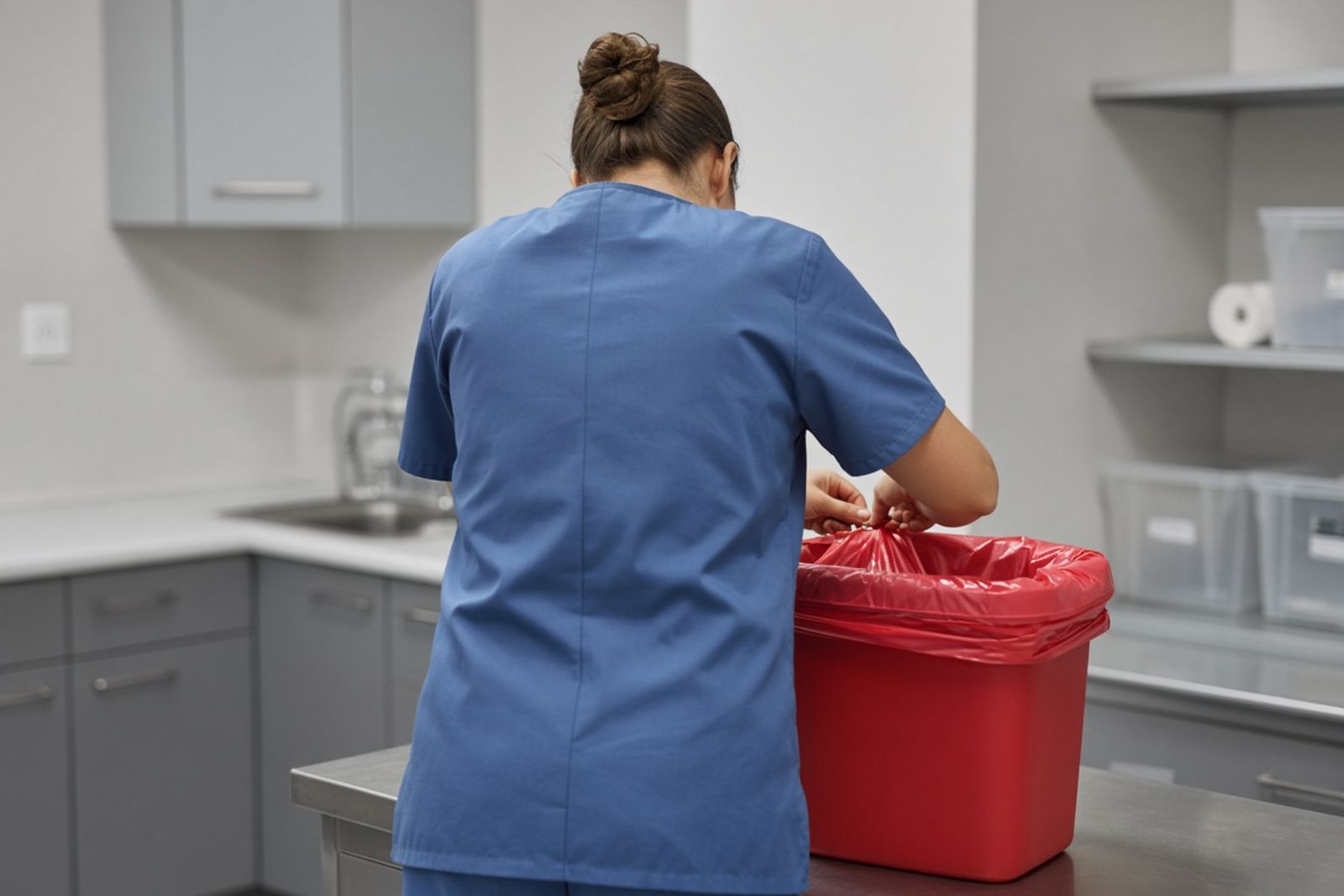
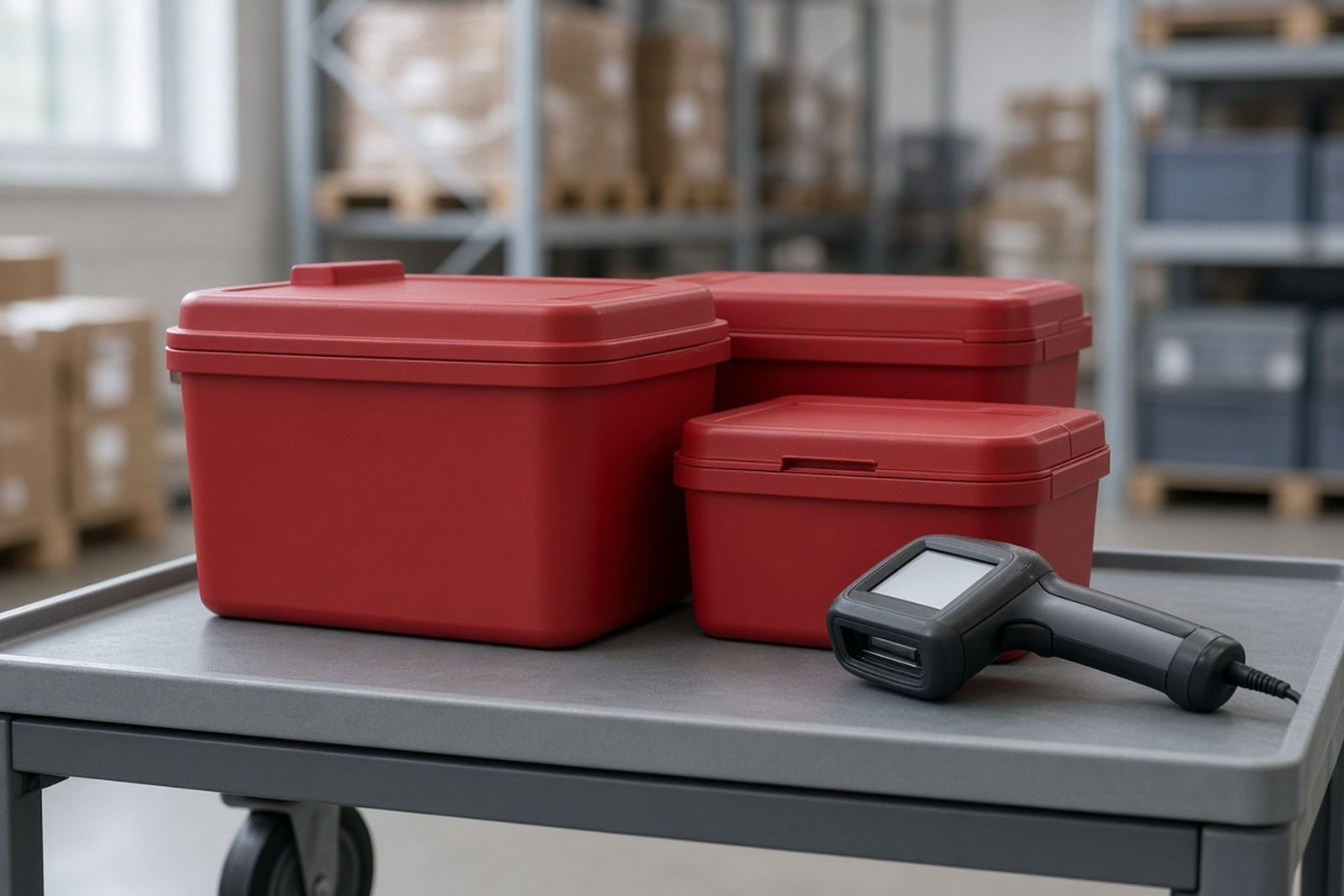
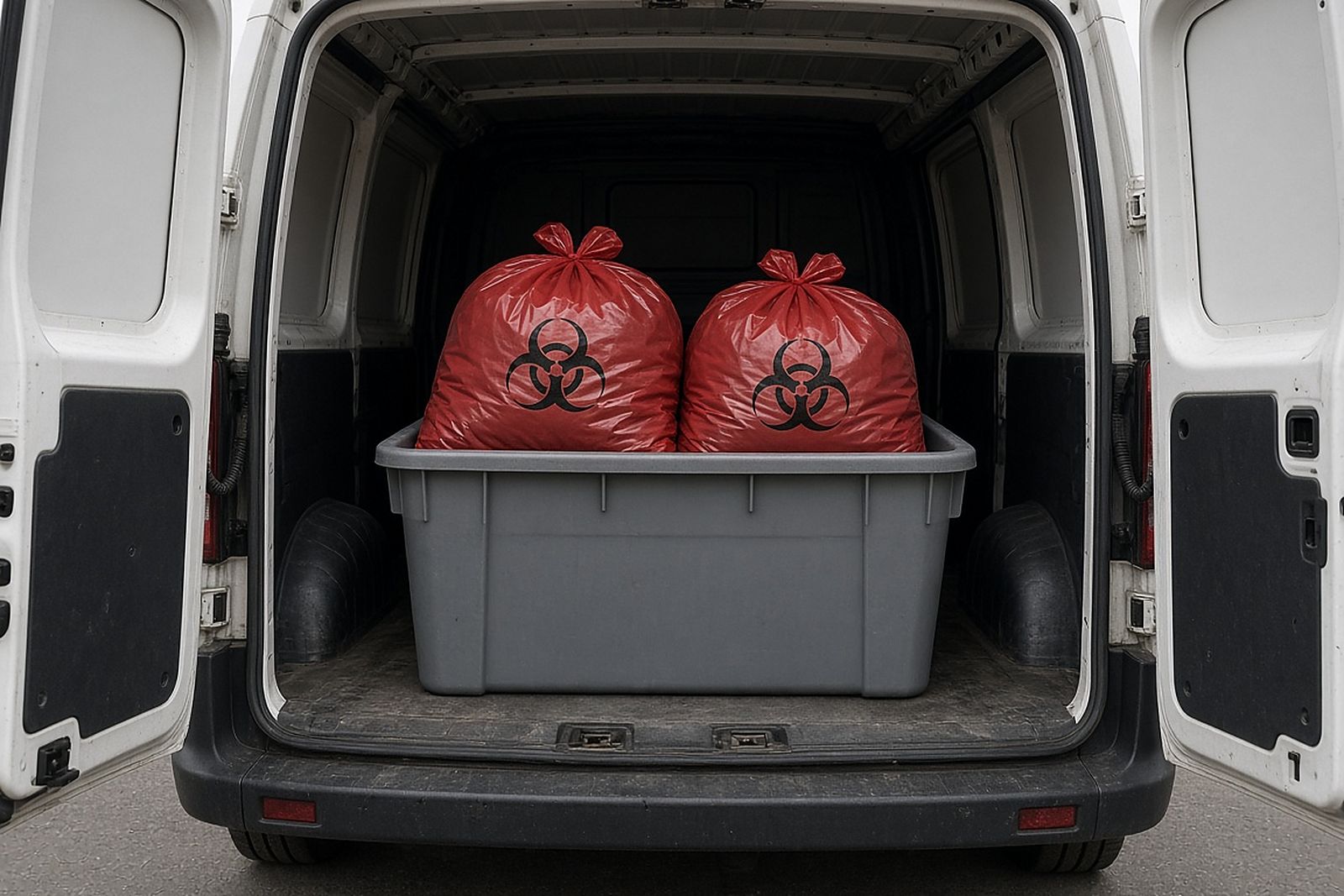
How a pickup usually works
Most businesses settle into a simple routine after the first few pickups.
- 1
Setting up service
The hauler asks what kinds of waste you make and roughly how much. They supply the right boxes, bags and sharps containers, or tell you which ones to buy.
- 2
Packing and labeling
Staff fill containers only to the fill line, then close and label them. Needles go in hard plastic containers, and soft waste goes in red bags inside a sturdy box.
- 3
Pickup day
The driver checks that each box is sealed and labeled, then counts or weighs it. Someone on your staff signs the shipping paper and keeps a copy.
- 4
Treatment
The waste goes to a treatment site that holds a state permit. There it is made safe, most often with steam or heat, before final disposal.
- 5
Closing the loop
The hauler or treatment site sends proof that your waste was treated. You match it to your copy of the shipping paper and file them together.
Biohazard Waste Transport by the numbers
Waste choices are easier when you see the whole picture, not just one bill. Size matters. A small dental office and a regional lab need very different containers, storage limits, and pickup schedules. Cost matters too. Prices depend on the type of waste, the container, and how often you need pickup, not a flat fee. Knowing what moves your bill helps you compare quotes fairly. Health facts matter because these rules exist to keep needles and infectious waste away from cleaning staff, drivers, landfill workers, and the public. The figures below come from cited sources. They are meant to ground your planning. They do not replace the rules your state and county enforce.
- 5 gallons
Inner packagings for liquid regulated medical waste may hold no more than 19 liters (5 gallons) under federal transport rules.
Read with care: Bulk outer packagings must retain at least 300 liters of liquid.
Source: DOT PHMSA (49 CFR via Cornell LII) (2024)United States, 49 CFR 173.197
- 12 hours
Hazmat incidents that kill or hospitalize someone, close a major artery for an hour, or involve infectious substances must be reported by phone within 12 hours.
Read with care: A written DOT Form 5800.1 is separately due within 30 days.
Source: DOT PHMSA (49 CFR via Cornell LII) (2024)United States, hazmat carriers
- $0.30-$0.80 per pound
Regulated medical waste disposal typically costs $0.30 to $0.80 per pound, with small physician practices paying $75 to $200 per month.
Read with care: Published by a disposal vendor; regional pricing and minimum fees vary.
Source: MedPro Disposal (vendor pricing guide) (2026)United States, vendor pricing guide dated March 2026
- 44
San Francisco walkthroughs found 44 discarded syringes per 1,000 census blocks versus 371 in Miami.
Read with care: Cities differ in many ways; Miami baseline overlaps S062.
Source: Tookes et al. (2012)San Francisco and Miami selected-neighbourhood walkthroughs; 602 and 448 interviewees respectively.
- 97%
Self-reported any improper disposal fell from 97% before to 70% after implementation.
Read with care: Selected drug-affected areas; secular changes possible; baseline overlaps S063.
Source: Levine et al. (2019)Miami neighbourhood walkthroughs plus 448 pre-programme and 482 post-programme survey respondents.
- 34.1%
Among those noticing a box, 34.1% had used one.
Read with care: Selected neighbourhood; disposal-box users are not necessarily people who inject drugs.
Source: Roth et al. (2021)358 residents and 78 business respondents in Kensington, Philadelphia.
These figures are public research and agency data, not this network's own job records. Keep each number with its population, year and limits; none of them predicts cost, timing or outcome at a specific property.
What waste pickup costs and where insurance fits
Most haulers charge by the container or by weight, plus how often they visit. Distance from their route, the type of waste, and fuel or paperwork fees can add to the bill. A studio that fills one small sharps container a month pays very differently from a lab with weekly boxes. Mail-back boxes can suit very small producers. Ask for every fee in writing, including charges for boxes packed wrong.
Routine pickup is a normal cost of doing business, so insurance does not pay for it. Insurance matters when something goes wrong, such as a box that leaks inside your building or a worker who gets a needlestick. General liability, property and workers' comp policies each cover different pieces. Ask your agent which one would respond, and ask your hauler what insurance it carries.
Keep every signed shipping paper, every proof of treatment, your staff training records, and your hauler contract. Many states set how long you must keep these, so check yours. If an inspector visits, these papers show the waste left your hands the right way. They also help you trace a box that goes missing.
How to choose a waste hauler
Price matters, but a missed pickup or a lost record can cost you more. These questions help you compare.
Questions to ask
- Which state and local permits do you hold for hauling medical waste? Ask for copies, since some states require you to check.
- Where does our waste go, and can you name the treatment site? A trustworthy hauler says exactly where your boxes end up.
- What proof of treatment will we receive, and how soon? You need it to close out each pickup in your files.
- What happens if you miss a pickup? Storage time limits don't pause because a truck ran late.
- What fees can be added beyond the base price? Fuel, paperwork and repacking fees change what you actually pay.
- How long is the contract, and does it renew on its own? Some renew automatically and are hard to leave.
Warning signs
- They won't show permits or name the treatment site.
- They suggest tossing some red-bag waste in regular trash to save money.
- They skip the shipping paper or don't leave you a signed copy.
- The quote is far below others with no clear reason.
Checking a company you already have in mind? Work through the provider vetting checklist.
What your staff can do, and where the line is
Your team handles the daily part: putting waste in the right container, closing it, labeling it, and storing it. That is part of running a practice. Clear signs above each container and a short lesson for new staff prevent most mistakes.
What staff should not do is haul it themselves. Driving boxes to a landfill or treatment site in a personal car usually breaks state and federal rules and puts the driver at risk in a crash. Overfilled sharps containers need care too, because pressing down on a full one is a common way people get stuck.
Usually fine to do yourself
- Close and label containers once they reach the fill line.
- Keep a pickup log and file each signed shipping paper.
- Put fresh containers where staff use them most.
Leave to a trained crew
- Driving medical waste off your property.
- Treating or destroying the waste.
- Cleaning up a large leak or a broken box of needles.
- Handling chemical, drug or radioactive waste that got mixed in.
Not sure where your situation falls? The DIY risk check asks eight yes-or-no questions.
Free biohazard waste transport planning tools
Cost Range Estimator
Medical waste hauling is priced differently from trauma cleanup.
Provider Vetting Checklist
Choosing a medical waste hauler is a legal choice as much as a buying one.
Insurance Claim Organizer
Insurance rarely comes up with routine waste pickup.
First 24 Hours Planner
The first day after you become responsible for biohazard waste is when most avoidable mistakes happen.
Waste & Disposal Classifier
Most rule-breaking in this field starts with a sorting choice made in a hurry.
DIY or Call a Pro? Risk Check
In a business, the question is not whether you personally should touch medical waste.
What research has found
Findings from published studies of people and properties in situations like this one. They describe what researchers observed in a specific group; they are not predictions for your case.
Diabetes duration's unadjusted association disappeared after adjustment.
Knowledge gaps remained even among people who had received training.
Other reported disposal routes included recycling bins, toilets and accumulating items at home.
Biohazard Waste Transport community polls
Every count is a real visitor vote; nothing is seeded or padded. One vote per poll per device, and you can change your answer.
How does your business get medical waste off site now?
Which part of your waste program is most frustrating?
How sure are you that you could show an inspector a full year of shipping records?
Common questions about biohazard waste transport
Do tattoo and piercing studios need a medical waste hauler?
In most states, yes, at least for needles and items soaked with blood. Some states let very small studios use mail-back sharps boxes instead of a truck pickup. Your state or county health department can tell you what applies to body art shops. Ask before you open, since inspectors often check waste records during a studio's first visit.
Where do extracted teeth go in a dental office?
Teeth without fillings are usually treated as medical waste and can go in your regular medical waste container. Teeth with silver fillings contain mercury, so they should not go into waste that will be burned. They usually go to an amalgam recycler instead. Many states also let you return a tooth to the patient. Check with your state dental board.
When is a sharps container considered full?
When the contents reach the fill line printed on the side, which is often well below the lid. Stop using it there, even if it looks like there is room. Never push needles down to make space. Snap the lid closed, lock it if it has a lock, and place a new container in the same spot right away.
Can we share a waste pickup with the business next door?
Some states allow nearby businesses to share a pickup, but each one usually stays responsible for its own waste. That means separate labels and separate records. Sharing can save money for very small producers, but it gets messy if a box is packed wrong. Ask your state agency whether sharing is allowed and how the paperwork must be kept.
What should we do if a waste box is damaged before pickup?
Put on gloves and place the whole damaged box inside a larger container or a new box with a red bag. Don't open it or sort through it. Label the outer box the same way as the inner one. Clean any drips with a disinfectant, then tell your hauler before pickup so the driver knows what to expect.
What about waste from visits to patients' homes?
Home health nurses, mobile phlebotomists and hospice staff make waste away from the office. Some states let staff carry sealed, labeled containers back to the office for pickup. Others have different rules. Ask your state agency before setting up a plan, and give staff sturdy containers that stay closed in a car.
What happens if our hauler closes or is bought by another company?
Ask right away for copies of all your pickup and treatment records. Make sure the last few loads have proof of treatment before the old account shuts down. Read any new contract from the buyer closely, since prices and terms may change. If you choose a new hauler, set it up before your storage space fills.
More on biohazard waste transport
Biohazard Waste Transport services
See how medical waste hauling works, from packing and shipping records to permitted treatment, before you sign with a hauler.
Costs explained
What drives the price, published cost ranges, and how to read a written quote line by line.
Insurance and payment
Which policies may respond, how to document a claim, and what to do if coverage is denied.
Planning tools
Use planners to estimate pickup costs, check haulers, sort waste, and organize records for your medical waste program before you commit.
Community polls
See how other clinics, studios, labs, and property owners handle pickup schedules, paperwork, and hauler choices. See where opinions differ from the written rules.
Knowledge quiz
Test what you know about who is responsible, container rules, shipping records, and proof of treatment. Then review the study guide for anything you missed.
Articles and resources
Read practical articles on storage limits, mail-back programs, rejected loads, and building a waste file that holds up to an inspection or insurer audit.
Related guidance sites
Each site covers one situation. If yours overlaps, start with the closest match.

Needle & Sharps Disposal (Sharps Collection Guide)
Calm, plain steps for a loose needle in a yard, hallway, or park.

Biohazard Decontamination (Biohazard Care Guide)
Blood, sewage, or a bad outbreak of illness: what to do and whom to call.

Hazmat Spill Response (Spill Planning Guide)
Plain guidance for chemical, fuel and unknown spills at homes, shops and job sites.
Get answers by email
Send a short message about your biohazard waste transport situation. Your request is sent to the follow-up inbox. A coordinator can reply by email. There is no obligation.
Your request is sent to the follow-up inbox. A coordinator can reply by email.
If anyone is hurt or in danger, call 911 first.