Insurance for Biohazard Waste Transport: What Applies
Businesses stay responsible for waste even after it leaves their loading dock.
Medical or biohazard waste may get spilled, mishandled, or taken to the wrong place. When that happens, questions about who is responsible come fast. The business that made the waste, the hauler, and the treatment site each have duties. Several types of insurance may play a part. This guide explains which policies may apply, common gaps, how to document an incident, and what to check before you hire a hauler.
Get an email reply about biohazard waste transport
Send a short message to the follow-up inbox. A coordinator can reply by email. This form does not send emergency help; call 911 first if anyone is in danger.
What published figures say about coverage and payment
- 12 hours
Hazmat incidents that kill or hospitalize someone, close a major artery for an hour, or involve infectious substances must be reported by phone within 12 hours.
Read with care: A written DOT Form 5800.1 is separately due within 30 days.
Source: DOT PHMSA (49 CFR via Cornell LII) (2024)United States, hazmat carriers
- 46 gallons
Federal rules cap plastic film bags of solid regulated medical waste at 175 liters (46 gallons), and bags placed in carts or bulk packagings at 10 kg (22 lb) when filled.
Read with care: Packaging must also meet UN performance standards; state rules may be stricter.
Source: DOT PHMSA (49 CFR via Cornell LII) (2024)United States, hazmat regulations for UN3291 regulated medical waste
- $0.30-$0.80 per pound
Regulated medical waste disposal typically costs $0.30 to $0.80 per pound, with small physician practices paying $75 to $200 per month.
Read with care: Published by a disposal vendor; regional pricing and minimum fees vary.
Source: MedPro Disposal (vendor pricing guide) (2026)United States, vendor pricing guide dated March 2026
- 1991
The federal Medical Waste Tracking Act regulations expired on June 21, 1991, leaving medical waste primarily regulated by state environmental and health departments.
Read with care: EPA and DOT still regulate some aspects (e.g., transport, incinerator emissions).
Source: EPA (2024)United States, federal medical waste regulation history
- 90 days
New hazmat employees must complete required DOT training within 90 days of employment and may work only under direct supervision until then.
Read with care: Training covers general awareness, function-specific, safety and security awareness.
Source: DOT PHMSA (49 CFR via Cornell LII) (2024)United States, hazmat employees including medical waste transporters
- UN2814/UN2900/UN3549
Regulated medical waste containing a Category A infectious substance must be classed as an infectious substance and assigned UN2814, UN2900 or UN3549 rather than UN3291.
Read with care: Industry association compilation; consult the CFR text for authoritative wording.
Source: American Bio Recovery Association (citing 49 CFR 173.134) (2023)United States, 49 CFR 173.134(a)(5)
These figures are public research and agency data, not this network's own job records. Keep each number with its population, year and limits; none of them predicts cost, timing or outcome at a specific property.
Which insurance policies relate to biohazard waste transport?
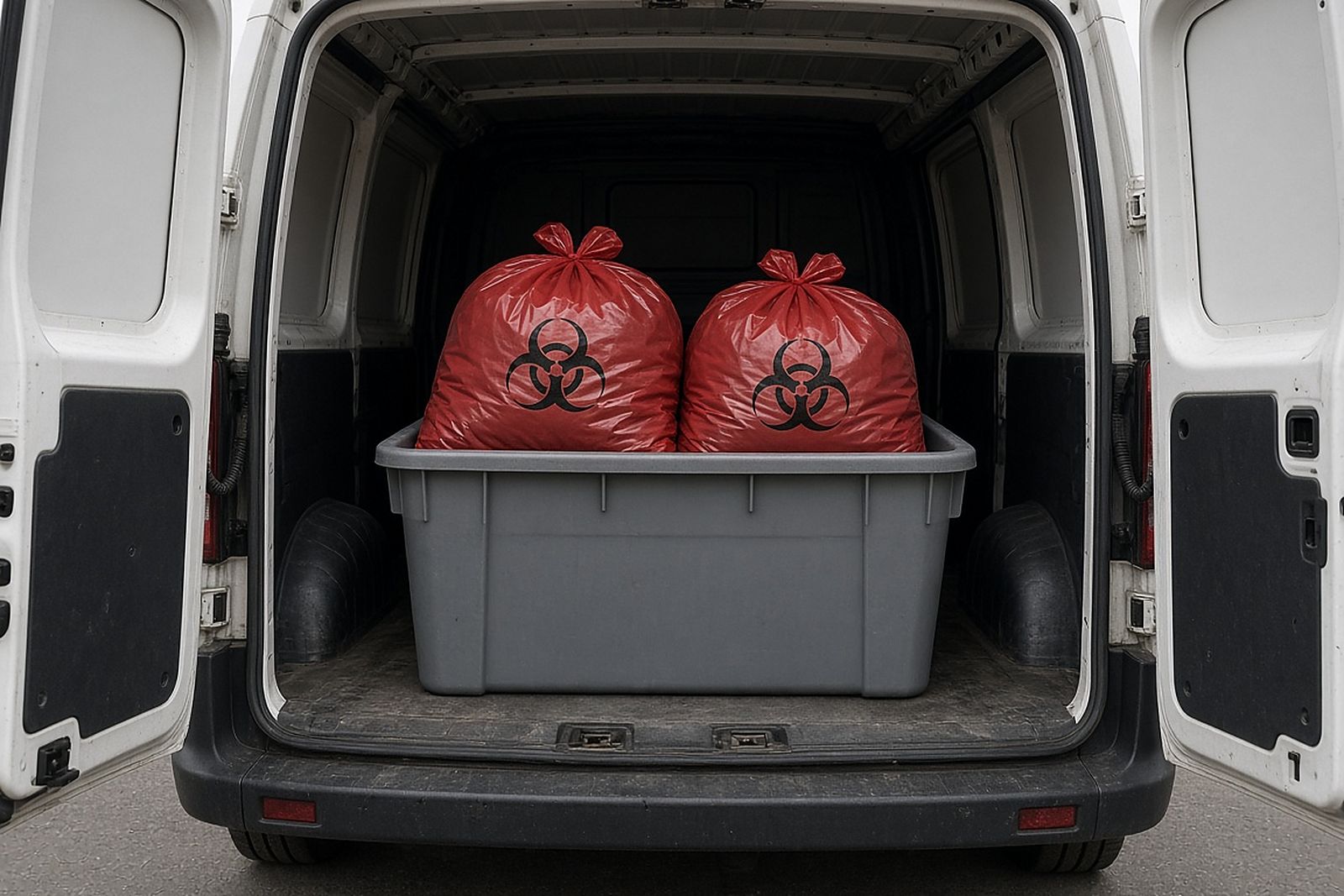
Haulers usually carry business auto coverage for their vehicles. They may also carry pollution liability coverage for spills during transport. General liability policies often exclude pollution. So a separate pollution policy or add-on can matter. Workers' compensation covers drivers and handlers who are hurt or exposed on the job. Limits and wording differ a lot between insurers. The details matter as much as the policy names. Ask each insurer for the full policy, not just a summary page.
Businesses that make waste include clinics, labs, and cleanup companies. They may carry their own general liability and professional liability coverage. Some also carry environmental or pollution coverage. Business property policies may pay when a spill damages a building, but contamination exclusions are common. The business that made the waste may stay responsible for it even after pickup. So it should review its own policies and not rely only on the hauler's coverage.
Why does 'cradle-to-grave' responsibility matter for insurance?
Many waste rules follow a 'cradle-to-grave' idea. The business that makes waste keeps some responsibility for it until it is properly treated. A hauler might mishandle your waste or take it to the wrong place. You may still face questions from regulators. That is one reason to choose a hauler carefully. It is also a reason to keep your shipping papers and treatment records in order. Good records are your best proof that the waste was handled responsibly at every step.
Who oversees medical waste varies from place to place. The EPA said in 2024 that the federal Medical Waste Tracking Act rules ended on June 21, 1991. Since then, medical waste has mainly been regulated by state environmental and health departments. Rules vary by state and county. Check with the local authority. Ask your broker how your policies line up with the rules where you work.
What exclusions commonly create coverage gaps?
Pollution exclusions are the most common gap. Many general liability and business property policies exclude damage from released contaminants. That may include biohazard or chemical waste. Some policies also exclude fines or penalties and rule-breaking on purpose. Some exclude problems that existed before the policy began. These exclusions can leave a business exposed right when it needs help. A pollution add-on or a separate policy is often how businesses close that gap.
Auto policies may limit coverage for cargo or for pollution released from a vehicle. Coverage for duties you take on by contract may also be limited. That matters when a transport agreement asks one party to cover the other's losses, called indemnifying. Review every policy's exclusions and add-ons. Ask your broker to explain in writing how each would apply to a spill, a wrong delivery, or an exposure incident.
What should you check before hiring a transporter?
Ask for certificates of insurance that show business auto, general liability, pollution liability, and workers' compensation coverage. Confirm the policy dates. Think about asking to be named as an additional insured where it fits. Check that the hauler holds any permits or registrations your state requires. Ask which treatment site gets your waste. Put these checks on a yearly calendar. Keep a copy of each certificate on file.
Ask how the hauler trains its staff. Federal transport rules set training duties for hazmat workers. DOT PHMSA, as shown in 2024 federal rules, says hazmat workers must get repeat DOT training at least once every three years. Some haulers can clearly describe their training, spill steps, and emergency contacts. Those haulers are more likely to handle problems well.
- Certificates of insurance with current dates
- Pollution liability, not just general liability
- State permits or registrations
- Named treatment site
- Training records and spill steps
How do you document a waste transport incident?
If a spill, leak, or wrong delivery happens, first make sure people are safe. Follow any emergency steps that apply. Then record what happened. Take photos of the containers, the vehicle, and the affected area. Note the times, names, and a description of the waste. Keep copies of shipping papers and any incident reports from the hauler or responding agencies.
Tell your insurer and the hauler right away. Ask what information they need. Keep a log of every conversation. If cleanup is needed, ask the cleanup contractor for an itemized plan and bill. Organized records help insurers understand what happened and which policy should pay. They also help you answer questions from regulators. Store copies in more than one place.
How should you work with adjusters and respond to a denial?
More than one insurer may be involved. That can include the hauler's auto and pollution insurers and your own liability insurer. Share documents quickly. Ask each adjuster to explain in writing which parts of the loss they are reviewing. Keep copies of everything you send and receive. Note any deadlines each insurer gives you. Insurers can take time to sort things out between them, so patience and good records help.
If a claim is denied, ask for the decision in writing with the policy language it relies on. See whether a different policy, like a pollution add-on, may apply instead. You can ask for a second review, send more evidence, or contact your state insurance department. For large losses, a lawyer who knows environmental or insurance matters may help you weigh your options.
How can a written contract reduce insurance disputes?
A clear service agreement spells out who does what at each stage. It can say who packs and labels waste and when the hauler takes charge of it. It can name the site that receives the waste. It can say what happens if a container leaks or is refused. It can also list the insurance each party must carry. And it can say whether either party must be named as an additional insured.
Read indemnity clauses with care. They decide which party pays the costs after an incident. Ask your broker or lawyer to review those terms along with your policies. Some policies limit coverage for duties you accept by contract. Look at the agreement again when it renews. Keep a signed copy with your certificates of insurance. Then everything is easy to find if something goes wrong.
Are there other sources of funding for waste-related costs?
If a hauler caused a spill, its insurers may be responsible for cleanup costs and damage to your property. Your contract with the hauler may also have indemnity terms that shift some costs. Sometimes waste comes from a cleanup after a crime. Then disposal may be part of the costs a victim compensation program considers for people who qualify. This depends on the state.
For households with needles used at home, local health departments or pharmacies sometimes offer free or low-cost disposal. Estates may pay disposal costs tied to cleanup after a death. Ask each possible source directly what it covers. Keep bills that show transport and disposal apart from other cleanup charges. Then reviewers can see each cost clearly. Separate line items also make it easier to ask more than one source for repayment.
Keep the claim organized
Biohazard Waste Transport insurance claim organizer
A checklist to keep the claim orderly. It stores nothing on our servers; copy the summary to your own notes.
0 of 18 steps recorded (0%)
Print or paste the summary into your own records. Coverage is the carrier's decision under the policy; keep every answer in writing.
Open the full tool page for a worked example and more answers.
What research has found
Findings from published studies of people and properties in situations like this one. They describe what researchers observed in a specific group; they are not predictions for your case.
Knowledge gaps remained even among people who had received training.
Education, knowledge and attitude jointly predicted reported disposal practices in the study model.
Insurance questions about biohazard waste transport
Does general liability insurance cover a biohazard waste spill?
Often it does not. Many general liability policies have pollution exclusions that may apply to biohazard or chemical spills. Some businesses buy separate pollution liability coverage or add-ons to fill that gap. Review your policy's exclusions. Ask your broker how a spill of regulated waste would be handled. Getting that answer in writing before an incident can prevent confusion later.
If my transporter spills my waste, am I still responsible?
You may still face questions. Businesses that make waste often keep some responsibility for it until it is properly treated. The hauler and its insurers may be responsible for cleanup and damage. That depends on the facts and your contract. Keep your shipping papers and records. Tell your own insurer. Think about talking to a lawyer if regulators contact you about the incident.
What insurance should a biohazard waste transporter carry?
At a minimum, look for business auto, general liability, pollution liability, and workers' compensation coverage. Ask for current certificates of insurance and check the policy dates. Some businesses also ask to be named as an additional insured. Requirements differ by location and contract. Ask your broker what limits and coverage make sense for your volume and waste types.
Does workers' compensation cover a needlestick during waste handling?
Workers' compensation usually covers employees who are hurt or exposed at work. That may include needlestick injuries while handling waste. Report any exposure right away. Follow your employer's steps after an exposure, including a quick medical exam. Keep records of the incident, the waste involved, and any medical care. The details depend on your state and your employer's policy.
Can I require my transporter to name me as an additional insured?
Many businesses put this in their contracts, and many haulers agree to it. Being named as an additional insured may give you some protection under the hauler's policy. It can apply to claims that come from the hauler's work. How much it covers depends on the policy wording. Ask your broker to review the certificate and the add-on. Make sure the requirement is written into your service agreement.
What records help most if an insurer investigates a waste incident?
Helpful records include shipping papers, treatment certificates, and your transport contract. So do the hauler's certificate of insurance, training records, photos of the incident, and a timeline of events. Sort them by date and incident. Clear records make it easier for adjusters to understand what happened. They also help you answer any questions from regulators.
Will insurance pay for waste disposal after a home cleanup?
A homeowners policy may cover a cleanup, such as after certain covered losses. Then disposal of the waste may be part of the covered costs. After a crime, a victim compensation program may help people who qualify with some cleanup costs. Ask your cleanup company to list transport and disposal charges separately. Then your insurer or program can review them clearly.
What other visitors said
Every count is a real visitor vote; nothing is seeded or padded. One vote per poll per device, and you can change your answer.
How does your business get medical waste off site now?
Which part of your waste program is most frustrating?
More on biohazard waste transport

Biohazard Waste Transport services
See how medical waste hauling works, from packing and shipping records to permitted treatment, before you sign with a hauler.
Costs explained
What drives the price, published cost ranges, and how to read a written quote line by line.
Planning tools
Use planners to estimate pickup costs, check haulers, sort waste, and organize records for your medical waste program before you commit.
Community polls
See how other clinics, studios, labs, and property owners handle pickup schedules, paperwork, and hauler choices. See where opinions differ from the written rules.
Knowledge quiz
Test what you know about who is responsible, container rules, shipping records, and proof of treatment. Then review the study guide for anything you missed.
Articles and resources
Read practical articles on storage limits, mail-back programs, rejected loads, and building a waste file that holds up to an inspection or insurer audit.