Short answer
Qualified biohazard waste transporters combine state registration or permits, DOT hazmat training for anyone who packages, loads, or drives regulated medical waste, OSHA bloodborne pathogen training, proper vehicles and containers, and a paper or electronic trail from pickup to treatment. As a generator, you should ask to see registration details and sample tracking records, then verify them with your state agency.
Three sets of rules, no single certificate
Moving regulated medical waste sits at the intersection of three sets of rules. Transportation rules from the U.S. Department of Transportation govern how hazardous materials are classified, packaged, marked, and documented on the road. Workplace safety rules from OSHA govern how workers are protected from blood and other infectious materials. State environmental or health agencies usually govern who may haul medical waste, where it may go, and how it must be tracked.
No single certificate covers all three. A qualified hauler holds whatever state registration or permit applies where it operates, trains its workers under both DOT and OSHA requirements, and keeps records that tie each pickup to a treatment facility.
When you evaluate a transporter, you are really asking whether it has built a program that meets each of those layers. The rest of this article walks through them one at a time.
What state registration tells you, and what it does not
State registration or permitting confirms that an agency knows the company exists, has received certain information about it, and in some cases has reviewed its vehicles, insurance, or procedures. The requirements range from a simple registration to a detailed permit with inspections.
Some states extend registration duties to generators who haul their own waste, with thresholds and fees tied to volume. That shows how specific state rules can be, and why a hauler's familiarity with your state matters.
Ask the transporter for its registration or permit number and the agency that issued it. Many agencies publish lists of registered transporters online or will confirm status by phone. If a hauler operates across state lines, ask which states it is registered in and whether that includes every state your waste will pass through or end up in.
Registration is a floor, not a ceiling. It tells you a company is allowed to operate, not that it operates well. Treat it as the first box to check, then look at training, equipment, and records to judge quality.
Why is DOT hazmat training required for drivers and loaders?
For transport purposes, regulated medical waste is a hazardous material. Anyone whose job affects its safe transport, including people who fill out shipping papers, package containers, load trucks, or drive, is considered a hazmat employee under federal rules.
Those workers need training in general awareness, their specific job functions, safety, and security. Federal rules also give new employees a limited window: within their first 90 days they must complete the required DOT training, and until then they may work only under direct supervision, per PHMSA's 49 CFR 172.704 as published in 2024.
The stakes for skipping training are real. Knowing violations of federal hazmat transport rules carry civil penalties up to $102,348 each, rising to $238,809 when death or serious injury results, and training violations have a $617 minimum, according to PHMSA's 2024 penalty rule at 49 CFR 107.329. A hauler that takes training seriously is protecting itself and, indirectly, you.
- General awareness and familiarization with hazmat rules
- Function-specific training for packaging, loading, or driving
- Safety training for emergency response and exposure prevention
- Security awareness for hazardous materials in transit
- Recurrent training on the schedule federal rules require
Bloodborne pathogen training
Bloodborne pathogen training is required for any worker who could reasonably be exposed to blood or other potentially infectious materials on the job. Drivers and plant workers handle containers that can leak or split, and a sharps container dropped the wrong way can cause a needlestick.
OSHA's Bloodborne Pathogens standard requires employers to have an exposure control plan, provide protective equipment, offer hepatitis B vaccination to exposed employees, and train them on hazards and procedures. It also requires long-term recordkeeping: employee medical records related to bloodborne pathogen exposure must be kept for the duration of employment plus 30 years, per OSHA's 2024 text of 29 CFR 1910.1030.
You will not see those medical records, and you should not ask for them. What you can ask is whether the company has an exposure control plan, how drivers are trained to respond to a leaking or damaged container, and what happens after an exposure incident.
Vehicle and container standards
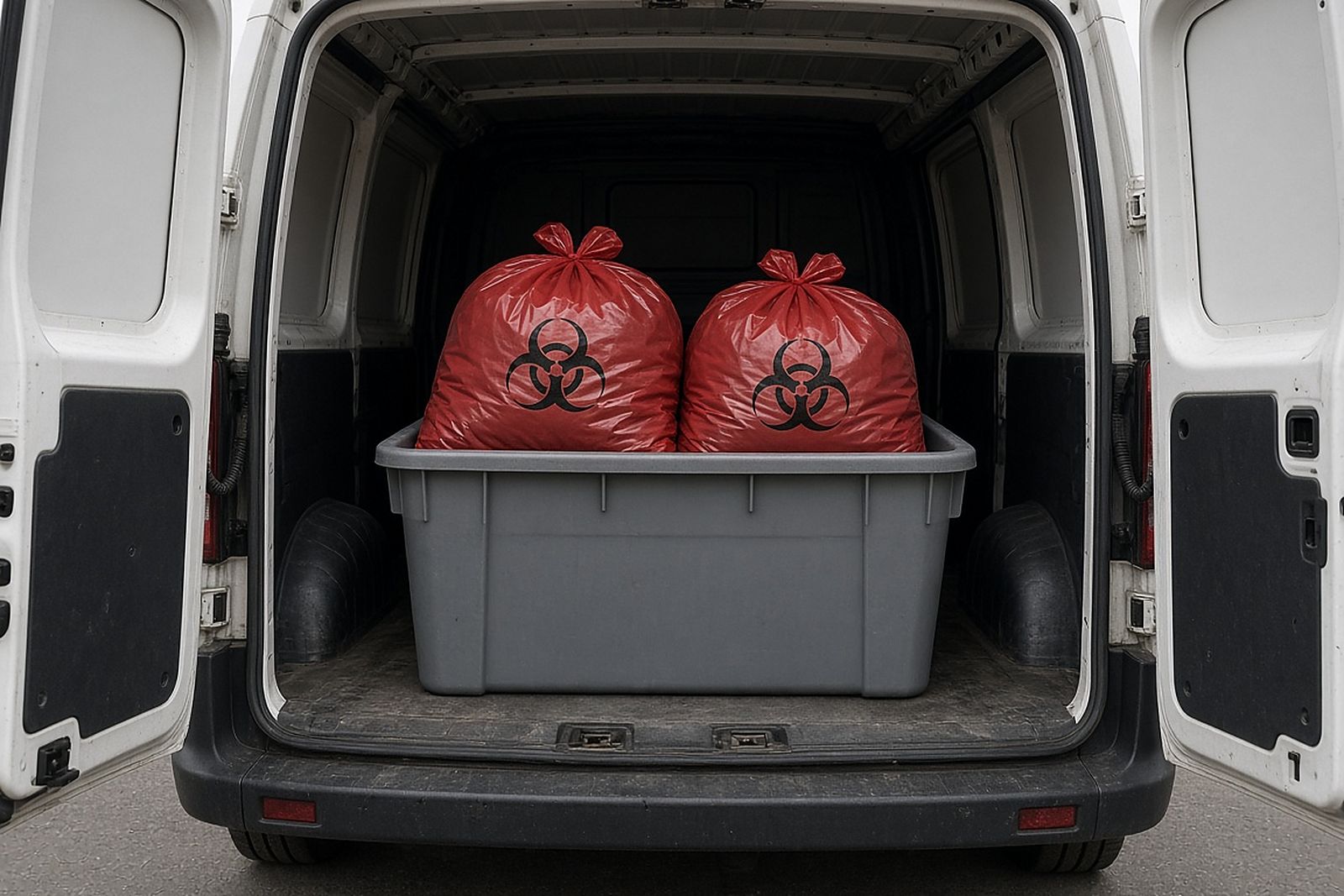
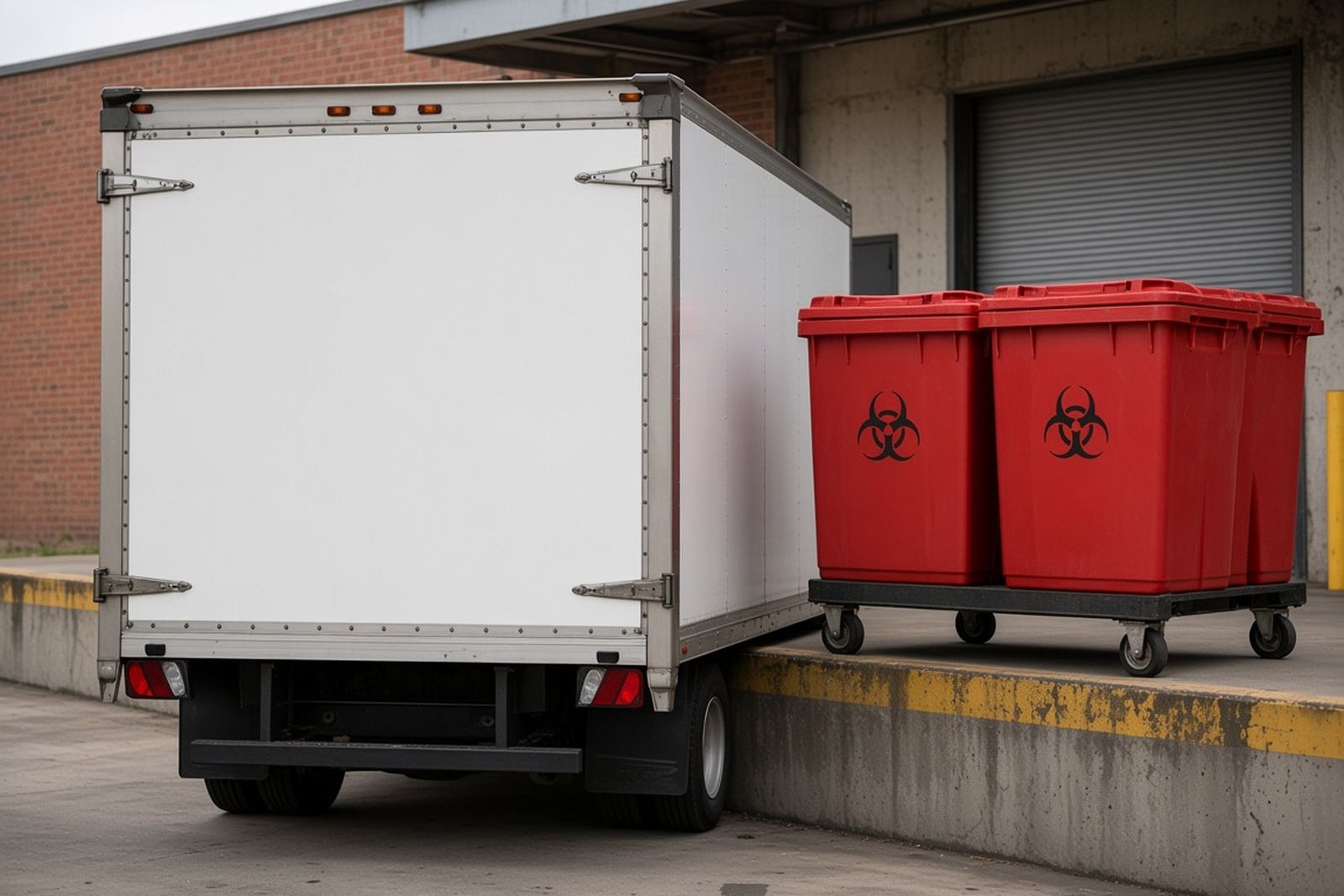
Training only works if the equipment supports it. Vehicles used for medical waste are commonly required to have enclosed, leak-resistant cargo areas that can be cleaned and disinfected, and many states require specific markings or placards. Some require refrigeration if waste is stored beyond a certain time.
Containers must meet federal packaging rules for regulated medical waste, including strength, leak resistance, and labeling. A qualified hauler supplies approved containers, explains which waste goes in each type, and refuses to accept containers that are overfilled, leaking, or improperly closed.
Ask how the company cleans reusable carts and tubs between customers, and how often its vehicles are cleaned and inspected. These are routine questions for a professional operation, and the answers should come easily.
It is also worth asking what the company does if a truck breaks down or is involved in a crash with your waste on board. A qualified hauler has a written procedure for securing the load, notifying the right agencies, and cleaning up any release. Drivers should carry spill supplies and know how to use them without waiting for instructions.
Records from pickup to treatment
Documentation is where a hauler's credentials become visible to you. Each pickup should generate a record showing the date, your business, the number or weight of containers, the type of waste, and the transporter. Many states require a manifest or tracking form that travels with the waste and returns to you, or a copy of it, after treatment.
Ask what form those records take, how quickly you receive them, and how long the hauler keeps them. Ask whether you will receive confirmation of treatment, such as a certificate of destruction or a signed manifest from the treatment facility.
Keep your own copies organized by date. Inspectors and auditors often ask generators to show where their waste went, and you should not depend on the hauler to answer for you.
- Pickup record with date, container count or weight, and waste type
- Shipping paper or manifest that meets DOT and state rules
- Confirmation that the waste reached a treatment facility
- Certificate of treatment or destruction where available
- Easy access to past records on request
Two haulers, one warehouse pickup
A contrast drawn for illustration makes the point: a trauma cleanup company that has just finished a job and is holding several boxes of regulated waste in its warehouse. The owner calls two haulers to compare service.
The first says it can come the same day. When asked for its state registration, the dispatcher is not sure. The driver who arrives has no shipping paper to complete and loads the boxes into an open pickup bed.
The second hauler provides its registration number on the first call, which the owner confirms on the state agency's website. Its driver checks that each box is closed and labeled, notices that one box is damp at a corner and asks that it be overpacked before loading, completes a shipping paper, and gives the owner a copy. A week later, the owner receives confirmation that the waste was treated at a named facility. That is what training and credentials look like when they are working.
How can I verify a transporter's claims?
Start with the registration or permit number and check it yourself with the issuing agency. Then ask for a certificate of insurance and confirm the coverage is current.
Ask the company to describe its training program in plain language: who delivers it, how often it repeats, and how new drivers are supervised. Ask for a sample of the records you will receive after each pickup. Ask for references from businesses that generate the same kinds of waste you do.
A transporter that answers these questions directly, without making you chase details, is showing you how it will handle your waste. One that becomes defensive or vague is showing you something too.
If you already have a hauler, the same checks apply. Confirm its registration is still active, compare its invoices to the records it sends you, and ask whether its training program has changed. Doing this once a year keeps a long relationship from drifting into habits neither side has reviewed.
Why credentials outweigh a low quote
Medical waste is one of the few services where a mistake by your vendor can become your problem. Improperly handled waste can be traced to its source, and generators may face questions or penalties under state rules even when the hauler made the error.
A transporter with real registration, trained workers, suitable vehicles, and a clean paper trail costs more to operate than one without them. That cost shows up in the price. When you compare quotes, weigh what each company can prove, not just what it charges.
Think of the extra cost as part of your own compliance program. You are paying for a partner that keeps your records clean, your staff safe at pickup, and your name off an inspector's list of problem generators.